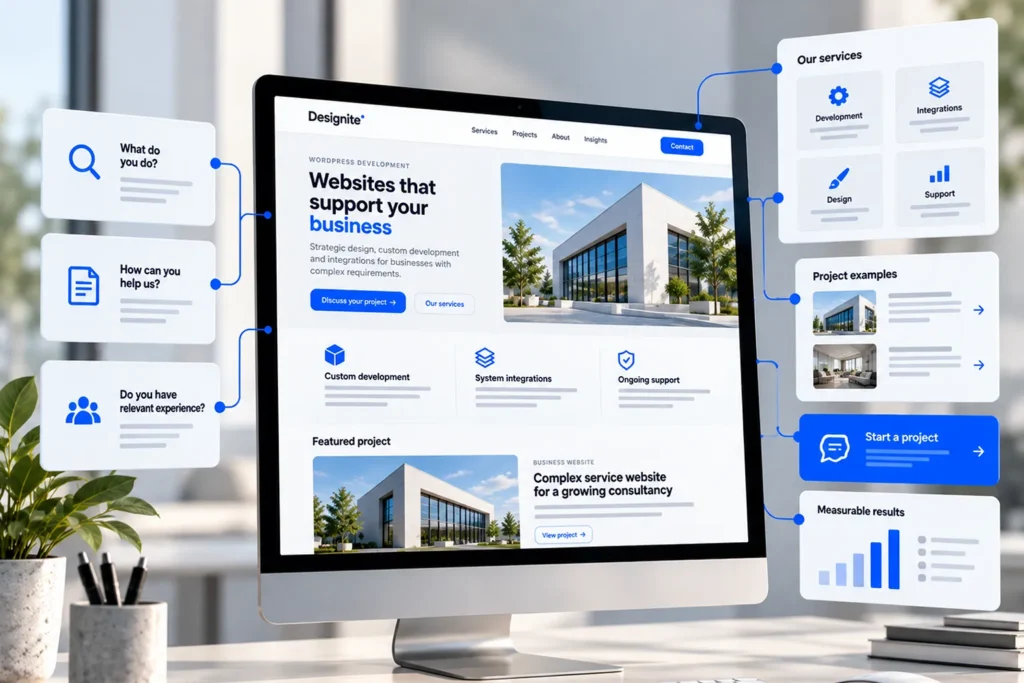
When businesses decide to build a new website, the first conversations often revolve around visual design. They discuss colours, typography, animations, layouts, and examples of websites they admire. These elements matter, but they are rarely the decisions that determine whether a website will actually support the business.
A visually impressive website can still struggle to generate enquiries, explain services, or guide customers towards a decision. Equally, an attractive homepage cannot compensate for confusing navigation, missing information, or functionality that does not reflect how the company operates.
A business website should be much more than an online presentation. It should communicate what the company offers, help visitors find relevant information, establish confidence, and support specific business objectives.
Achieving this requires planning before design begins.
The most effective website projects start by understanding the business, its customers, and the actions the website needs to support. Once these foundations are established, visual design becomes a way to communicate the strategy rather than an attempt to compensate for its absence.
A Business Website Needs a Purpose Beyond Looking Professional
Professional presentation is important. It influences first impressions and helps establish credibility. However, looking professional is not a measurable business objective on its own.
A website should serve a defined purpose within the company’s broader operations.
For a service business, that purpose might be attracting qualified enquiries and helping potential customers understand the available services. A B2B company may need to explain complex solutions, demonstrate expertise, and support a longer decision-making process.
An online store has different priorities. Customers need to find products, understand pricing, evaluate delivery conditions, and complete purchases without unnecessary complications.
These differences should influence how a website is planned from the beginning.
Define What Success Actually Means
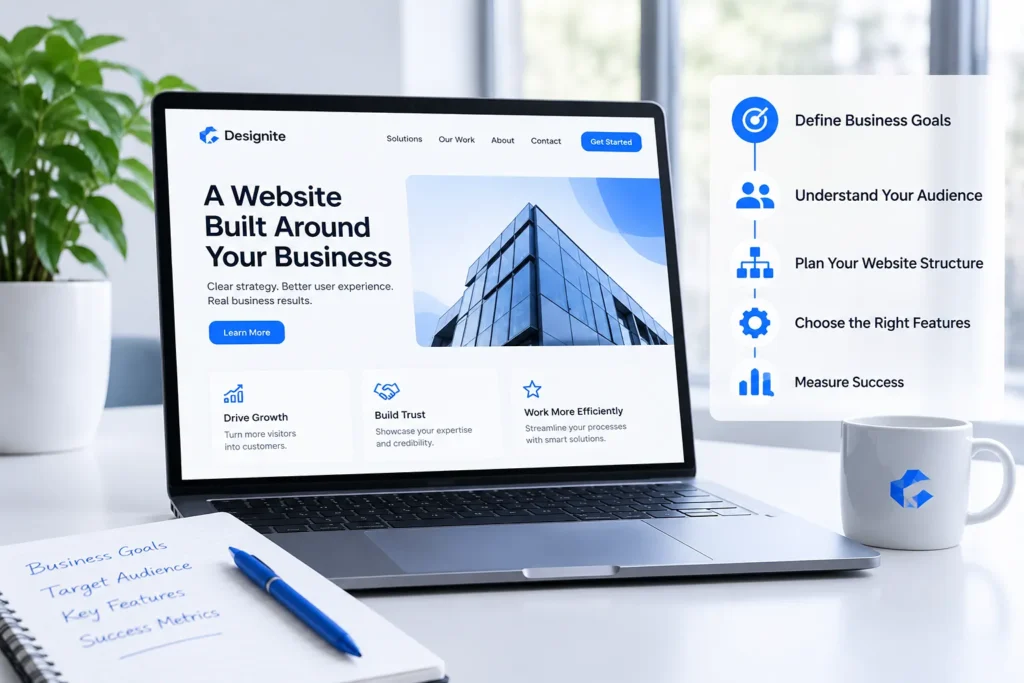
Before discussing layouts or visual references, a business should identify what it expects the website to accomplish.
Generating more traffic might sound like an appropriate objective, but traffic alone does not explain whether the website is commercially effective.
If a website attracts hundreds of additional visitors who never submit an enquiry, purchase a product, or take another meaningful action, increased traffic may have limited business value.
For a service company, useful indicators might include qualified enquiries, consultation bookings, and the proportion of visitors who reach important service pages.
The point is not to attach performance targets to every element of a website. It is to establish clear priorities that guide decisions throughout the project.
Without those priorities, website development can become a collection of visual preferences rather than a coordinated business investment.
Understand the People Who Will Actually Use the Website
Businesses naturally approach their websites from an internal perspective. They understand their services, terminology, processes, and organisational structure.
Potential customers often see things differently.
They may not recognise the technical names of services or understand how individual offerings relate to their requirements. Their first concern is usually whether the business can solve a particular problem.
This distinction matters when developing website content and navigation.
Identify Customer Questions and Decision-Making Needs
Consider a company offering several specialised professional services.
Internally, those services might be organised according to departments or technical disciplines. However, customers may search for solutions based on their industry, operational challenges, or desired outcomes.
A website structured entirely around internal terminology can make it difficult for visitors to recognise which service is relevant to them.
Understanding the customer’s perspective allows businesses to organise information around real questions.
What does the company provide? Who is the service suitable for? What does the process involve? What information is needed before making contact?
These questions should influence page content, navigation labels, and calls to action.
Research into information architecture consistently highlights the importance of helping people understand how information is organised. The Nielsen Norman Group’s research on information architecture examines how website navigation and information structures affect people’s ability to locate relevant content.
The underlying principle is straightforward: visitors should not need to understand your internal business structure to use your website effectively.
Website Structure Should Come Before Page Design
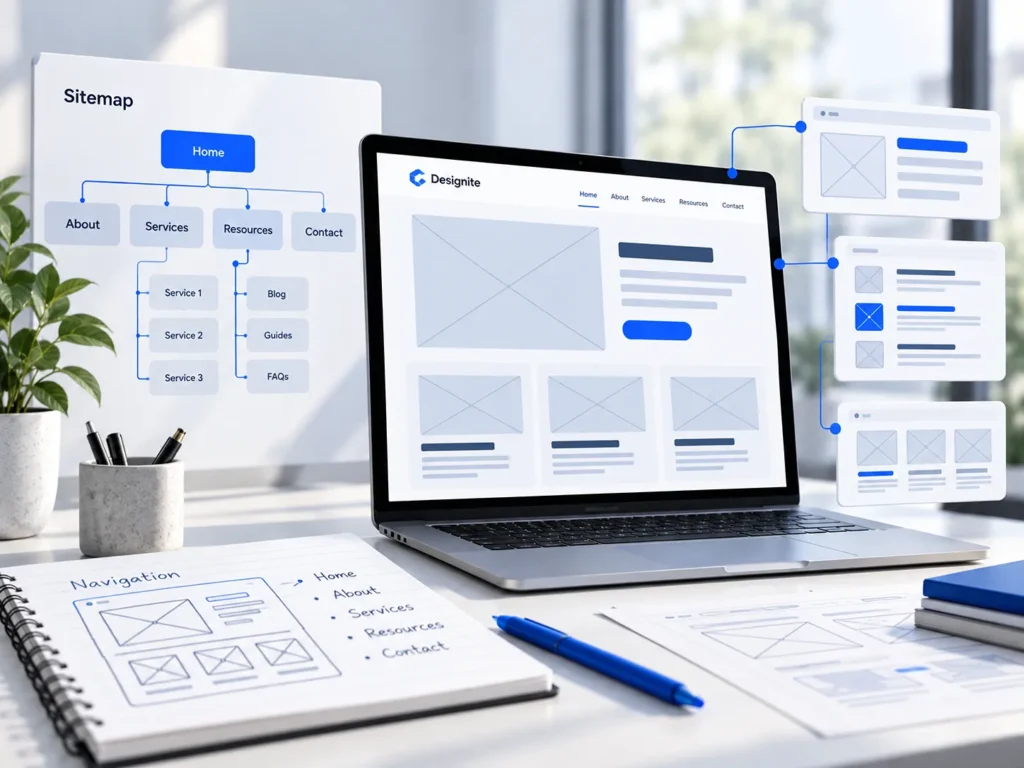
One of the most important stages of website planning is deciding what information belongs on the website and how its pages connect.
This process is often underestimated because its results are less immediately visible than a finished design.
Yet the structure determines how easily visitors can explore the website, understand relationships between services, and reach the information they need.
Build a Logical Information Hierarchy
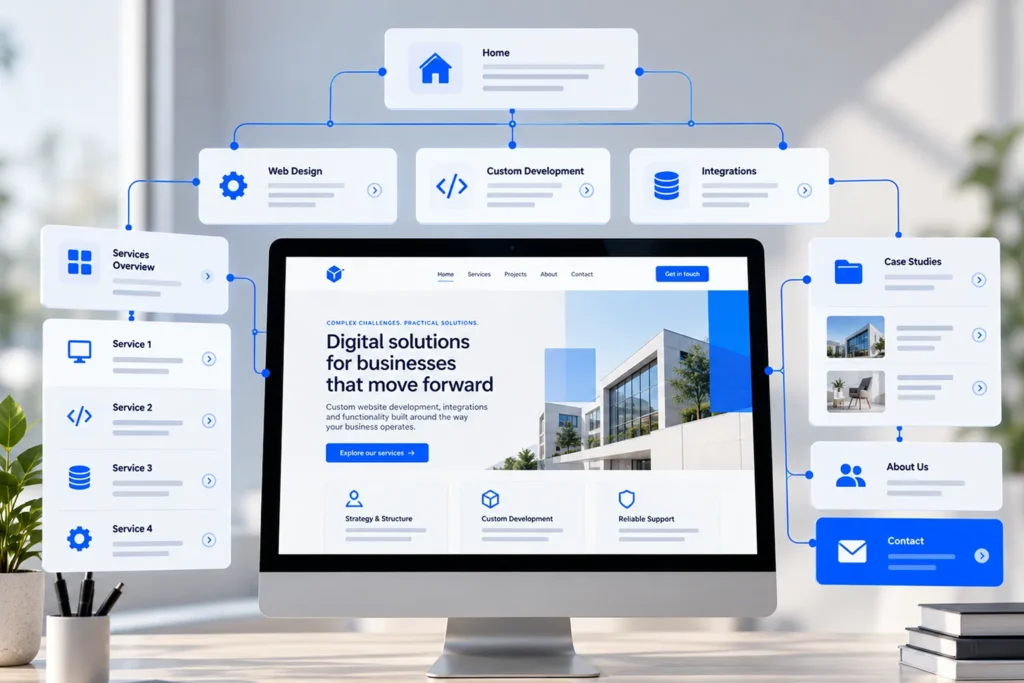
A typical business website might include a homepage, service overview, individual service pages, company information, projects, and contact details.
The existence of these pages is not particularly important by itself. Their responsibilities and relationships are what matter.
The homepage should introduce the business and direct visitors towards relevant areas. Service overview pages should help people understand the available solutions, while individual service pages provide the information required to evaluate a specific offering.
Project pages can demonstrate practical experience. Contact pages should make the next step clear and remove unnecessary obstacles.
Businesses with complex offerings may require an additional organisational layer, but adding more pages does not automatically create better structure.
The objective is to make information understandable and accessible.
For a more detailed examination of this challenge, our article on structuring websites for businesses with complex services explores how complicated offerings can be organised into clearer navigation and page structures.
Give Every Page a Defined Responsibility
A common website planning problem occurs when every page tries to communicate everything about the business.
Service pages repeat company introductions, the homepage contains excessive technical detail, and important information becomes scattered across multiple locations.
This makes the website harder to maintain and can create confusion for visitors.
Defining the responsibility of each page helps prevent unnecessary repetition and creates opportunities for more focused content.
It also provides a clearer framework for designers and developers, allowing them to build page layouts around the information each section needs to communicate.
A Website Should Support Real Customer Journeys
Visitors rarely explore a website in exactly the order a business expects.
Someone might arrive through a search result on an individual service page. Another visitor could follow a link to a project example, while an existing customer may go directly to the contact page.
Each visitor needs enough context to understand where they are and what to do next.
This is why website planning should consider journeys rather than treating pages as isolated designs.
Connect Information With Meaningful Actions
Imagine a potential customer researching a website development partner.
They may begin by reading about a specific service, then examine completed projects, learn more about the company’s approach, and finally decide whether to make contact.
A well-planned website supports this process by connecting relevant information.
A service page can link to a related project. The project can explain the requirements and implementation decisions. A clear contact option allows the visitor to continue when ready.
This is more useful than placing identical, aggressive calls to action throughout every page.
The purpose of a good user journey is not to pressure visitors into converting immediately. It is to help them make informed decisions and move forward with confidence.
Our article on why service pages should do more than describe a service examines this relationship between useful content, trust, and conversion paths in greater detail.
Functionality Should Reflect How the Business Operates
Website functionality is another area where early planning makes a substantial difference.
Many businesses begin with a list of desired features: contact forms, booking systems, customer dashboards, product catalogues, or integrations with external software.
However, choosing the technology before understanding the workflow can create unnecessary complexity.
Start With the Business Process
Consider a service business that wants customers to request quotations online.
A simple contact form might initially appear sufficient. But what happens after the form is submitted?
Does the enquiry need to reach a specific department? Should it create a record in a customer management system? Does the business require supporting documents, automated notifications, or different workflows depending on the requested service?
These questions affect how the functionality should be developed.
A standard plugin might handle a basic enquiry process perfectly well. More complex requirements could benefit from custom development or an integration with an existing business system.
The right solution depends on how the company operates, not simply which features are available in a particular website builder.
This is especially important for WordPress projects, where businesses can choose between existing extensions and purpose-built functionality.
For further context, our article on when a WordPress plugin is the wrong solution explores how to evaluate these technical decisions.
Plan for Future Changes
A website should also accommodate realistic business development.
New services, additional languages, expanded product ranges, or external integrations may become necessary as the company grows.
Planning for these possibilities does not mean building functionality that may never be used.
Instead, it means establishing a maintainable foundation, with appropriate content structures, reliable development practices, and technical decisions that do not unnecessarily restrict future improvements.
Accessibility, Performance and Search Visibility Are Part of the Foundation
A website cannot be considered effective if important visitors struggle to use it.
Accessibility, performance, and search visibility should therefore influence planning rather than being treated as corrections after visual design is completed.
Consider Accessibility From the Beginning
Accessible website design includes readable content, sufficient colour contrast, logical headings, keyboard-friendly navigation, and forms that clearly communicate their requirements.
These considerations improve usability for a broad range of visitors.
They also carry regulatory importance in the European Union.
The European Accessibility Act introduced accessibility requirements applying from 28 June 2025 to certain products and services, including covered e-commerce services, subject to scope, exemptions, and national implementation.
Businesses can review the European Commission’s overview of accessible products and services to understand the relevant framework.
Addressing accessibility during design and development is generally more efficient than attempting to correct fundamental structural issues after launch.
Build Performance and SEO Into the Project
Performance also depends on decisions made long before a website goes live.
Image handling, page layouts, script usage, hosting infrastructure, and third-party functionality all influence loading speed and responsiveness.
Likewise, search engine optimization begins with clear website architecture, appropriate page content, descriptive headings, and accessible navigation.
Google’s guidance on creating helpful, people-first content emphasises providing useful information that serves the intended audience rather than producing content primarily to influence search rankings.
These elements should shape the website’s foundation, not appear as a final checklist once the visual design has been approved.
A Business Website Needs to Communicate Trust
Trust is often discussed as a visual design objective, but professional typography and attractive photography are only part of the equation.
Visitors also evaluate whether a business communicates clearly, provides sufficient information, and appears capable of delivering what it promises.
A service website should explain its work in terms that potential customers can understand.
For businesses offering technical or specialised services, examples of completed work can be particularly valuable. They help connect abstract descriptions with practical implementation.
Demonstrate Capability Rather Than Relying on Claims
Statements about quality, reliability, or expertise are common across business websites.
However, these statements become more meaningful when supported by relevant information.
A project case study can explain the original requirements, the challenges encountered, and the solutions implemented.
A clear service page can demonstrate technical understanding by describing practical considerations, limitations, and implementation decisions.
Transparent information about the company’s process can also help potential customers understand what collaboration involves.
Trust develops through the overall experience, not through a single testimonial section or a collection of promotional statements.
Measure Whether the Website Is Supporting the Business
Once the website launches, its effectiveness should be evaluated against the objectives established during planning.
This is where many website projects lose momentum.
After the launch, attention often moves elsewhere, leaving businesses with little understanding of how visitors interact with the finished website.
Evaluate Outcomes, Not Only Traffic
A website’s performance should be assessed through meaningful activity.
For a service business, this might involve understanding which pages contribute to qualified enquiries and whether contact forms are being completed successfully.
For a B2B website, it could involve consultation bookings, engagement with project examples, or enquiries about specific solutions.
Measurement also requires context.
A higher number of submissions does not necessarily indicate better performance if the quality of enquiries decreases.
Similarly, a low conversion rate may reflect an unsuitable traffic source rather than a problem with the website itself.
Analytics should help businesses identify questions worth investigating, not simply provide numbers for reporting.
Keep Improving the Website After Launch
As customer expectations, services, and business processes change, websites need to evolve.
Content may require refinement, navigation can be improved, and new functionality may become necessary.
The European business environment illustrates why ongoing digital development matters.
According to Eurostat’s Digitalisation in Europe 2026 report, 71% of EU small and medium-sized enterprises reached at least a basic level of digital intensity in 2025, still below the EU’s 2030 target of 90%.
This measure covers broader digital technology adoption rather than website quality specifically. Nevertheless, it provides useful context for why businesses should treat digital capabilities as an ongoing investment rather than a one-time project.
A website built around clear objectives is easier to evaluate and improve because its original purpose remains understandable.
Visual Design Should Support the Strategy, Not Replace It
None of this suggests that visual design is unimportant.
Good design helps communicate professionalism, makes information easier to understand, and creates a recognisable identity.
The distinction is that visual decisions become more effective when they respond to established requirements.
Typography can reinforce the information hierarchy. Layouts can support the intended user journey. Colour and visual emphasis can help visitors recognise important actions.
Animations and interactive elements can contribute to the experience when they serve a meaningful purpose.
Without a clear strategy, however, these elements risk becoming decoration.
An impressive website might attract attention, but a well-planned website gives that attention somewhere useful to go.
Build the Right Website Before Building an Impressive One
A successful business website begins with understanding what the business needs to achieve and how its customers make decisions.
That understanding should guide the structure, content, functionality, and technical foundation before detailed visual design begins.
When these elements work together, design becomes more purposeful. The website is easier to use, its content is more relevant, and its functionality better supports daily business operations.
The result is not necessarily a more complicated website. Often, the greatest improvement comes from removing unnecessary complexity and making important information easier to access.
At Designite, we approach website design and development as a business-focused process. Our work connects clear website structures with practical WordPress development, custom functionality, and integrations tailored to operational requirements.
If you’re planning a new website or reconsidering an existing one, the most useful starting point is not deciding how impressive it should look.
It’s understanding what it needs to do.
Discuss your website project with Designite and explore how the right structure, design, and functionality can support your business.