When businesses plan an online store, the initial discussions often focus on what customers will see. Product photography, category layouts, navigation, promotional banners, and checkout design naturally receive considerable attention.
These elements are important. A well-designed storefront helps customers understand products, compare alternatives, and complete purchases confidently.
However, some of the most demanding parts of an e-commerce project are rarely visible to customers.
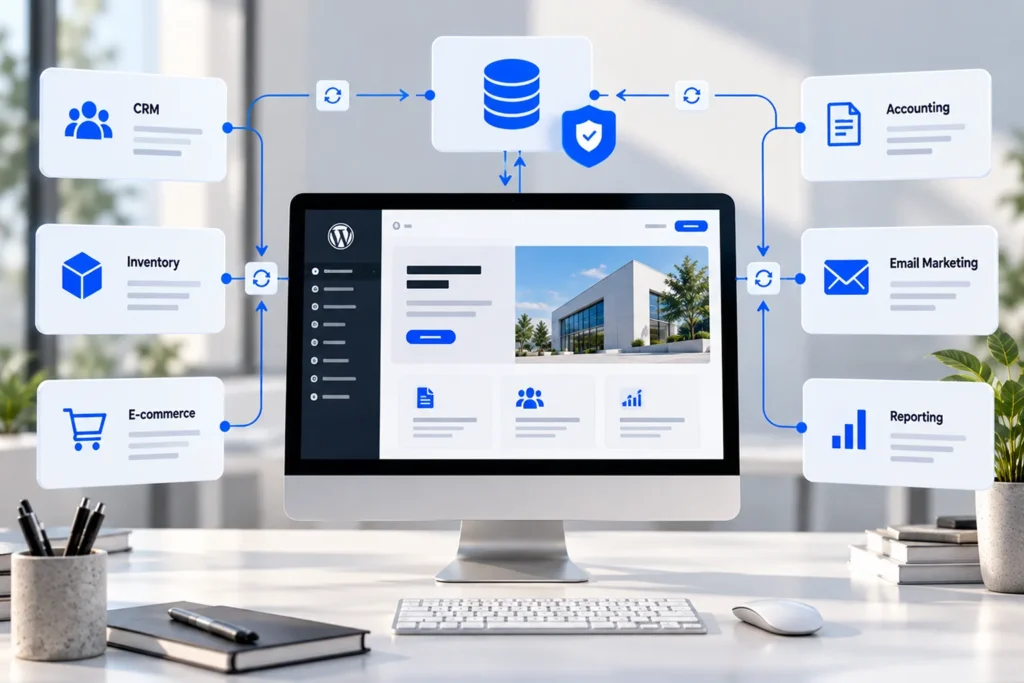
Behind every product page sits information that needs to be organised and maintained. Prices may depend on customer groups, product configurations, discounts, or tax rules. Inventory must remain accurate, orders need to move through appropriate fulfilment processes, and external systems may need to exchange information reliably.
As an online business grows, these operational requirements often become more complicated than the storefront itself.
For businesses using WooCommerce, understanding this distinction is essential. The platform provides a flexible e-commerce foundation, but implementing it successfully requires decisions that go beyond selecting a theme and configuring products.
The Storefront Is Only One Part of an E-commerce Website
Customers experience an online store primarily through its frontend interface.
They browse categories, inspect products, select options, and place orders. Ideally, these activities feel straightforward, regardless of the systems operating behind them.
For the business, however, every customer action can involve several connected processes.
Adding a product to the cart may require inventory checks, pricing calculations, eligibility rules, and shipping restrictions. Completing an order can initiate payment confirmation, stock adjustments, invoicing, notifications, and fulfilment workflows.
The apparent simplicity of the customer experience depends on the reliability of these underlying operations.
Why Operational Complexity Matters
The European e-commerce market provides useful context for these requirements.
According to Eurostat’s Digitalisation in Europe 2026 report, 78% of EU residents aged 16 to 74 purchased or ordered goods or services online in 2025, compared with 62% in 2015.
Eurostat
The same publication reports that 35% of recent online shoppers encountered problems in 2025. Among the difficulties reported were delivery delays and websites that were difficult to use or did not function satisfactorily.
These findings do not establish that backend problems caused every reported difficulty. They do, however, illustrate why the complete purchasing experience matters.
A visually attractive store is valuable, but it must be supported by processes capable of delivering what customers have been promised.
Product Data Is More Complicated Than a Product Page
A product page may display a title, description, image, price, and purchasing button.
Behind that presentation, businesses frequently manage substantially more information.
Products can have variations, technical specifications, categories, supplier references, availability conditions, and relationships with other products.
The way this information is structured affects both the customer experience and daily administration.
Product Variations and Structured Information
Consider an online retailer selling furniture.
A single product might be available in different materials, colours, dimensions, and configurations. Some combinations may be unavailable, while others require different prices or delivery arrangements.
Simply creating every possible combination without considering the underlying data structure can make the catalogue difficult to maintain.
WooCommerce supports variable products, attributes, and product metadata, but the implementation needs to reflect how the business manages its inventory and purchasing options.
For more complex catalogues, custom fields, specialised product relationships, or external product information systems may become necessary.
Good product architecture helps administrators maintain accurate information while ensuring customers only encounter valid purchasing choices.
Consistency Across the Catalogue
Another challenge appears when product information originates from multiple suppliers or internal departments.
Product descriptions may use inconsistent terminology. Measurements might follow different conventions, while some records lack important specifications.
These problems should be resolved through data management rather than relying exclusively on frontend design.
A consistent content structure supports navigation, filtering, product comparison, and search visibility.
It also makes future changes easier because information can be updated systematically instead of being corrected across individual pages.
Pricing Rules Often Require Custom Business Logic
For a straightforward store, product pricing may involve little more than a regular price and an occasional promotional discount.
Other businesses operate under considerably more complex conditions.
Wholesale customers may receive negotiated prices. Certain products might qualify for volume discounts, while promotional offers could depend on product combinations or customer eligibility.
These requirements need to be translated into predictable rules.
When Standard Pricing Features Are Not Enough
Imagine a business selling products to both individual consumers and professional customers.
Retail customers see standard prices, while approved business accounts receive different pricing conditions.
Some business customers may also qualify for quantity-based discounts or individual contractual arrangements.
It may be possible to implement these requirements using existing WooCommerce extensions.
However, difficulties arise when multiple plugins attempt to modify prices independently.
For example, one extension might calculate a customer discount while another applies a promotional offer. A third could alter pricing based on the quantity purchased.
Without a clear calculation order and defined exclusions, the final amount can become inconsistent.
A custom pricing implementation may be more appropriate when the rules are highly specific or form a central part of the company’s operations.
Our article on when a WordPress plugin is the wrong solution explores how to evaluate these decisions.
Promotional Pricing Requires European Considerations
Businesses selling consumer goods within the European Union must also consider applicable price indication rules.
Under EU rules, announcements of price reductions generally need to identify the lowest price applied during at least the previous 30 days, with specific exceptions and national implementation provisions.
The European Union’s consumer pricing guidance explains these requirements.
Your Europe
For WooCommerce stores, this can make historical pricing information important, particularly when running regular promotional campaigns.
A simple sale price field may not provide every capability required for a business’s particular pricing and compliance arrangements.
Inventory Management Connects the Website to Real Operations
Inventory accuracy is one of the most important operational responsibilities of an online store.
A product displayed as available should correspond to stock that can actually be fulfilled, subject to any clearly communicated availability conditions.
This becomes challenging when a company sells through multiple channels.
Synchronizing Stock Across Different Systems
A business may operate a physical shop, an online store, and one or more external marketplaces.
If these channels use independent inventory records, stock quantities can become inconsistent.
A product sold in the physical store may remain available online until a manual update occurs.
Similarly, an order placed through a marketplace could reduce inventory that the WooCommerce website still considers available.
An integration with an inventory or ERP system can help coordinate this information.
However, successful synchronization requires decisions about which system owns the stock records, how frequently information is updated, and how conflicts are resolved.
Handling Errors and Delayed Updates
Integrations do not always operate without interruptions.
An external system may become temporarily unavailable, an API request could fail, or information might arrive in an unexpected format.
A reliable implementation needs to account for these situations.
Depending on the business requirements, this might involve retry mechanisms, error logs, administrator notifications, and reconciliation processes.
The goal is not simply to transfer data when everything works correctly. It is to prevent temporary failures from creating inaccurate business records.

Checkout Is Where Several Systems Must Work Together
Checkout is often treated as a design challenge, particularly when businesses want to simplify the purchasing experience.
While usability is important, the checkout also coordinates several technical processes.
Customer information must be validated, totals calculated, shipping options determined, and payment transactions processed.
The order then needs to be recorded correctly.
Payment Processing and Order Reliability
An unsuccessful payment should not normally be treated as a completed, paid order.
Likewise, a successful transaction should not disappear from the store because an external confirmation message was delayed.
Payment gateways often communicate with e-commerce platforms through asynchronous notifications.
WooCommerce implementations need to handle these events consistently and avoid processing the same event multiple times in ways that create incorrect records.
Custom checkout functionality must also consider how taxes, shipping, discounts, and refunds interact.
These details matter because the consequences of an error extend beyond the website interface.
They may affect accounting, fulfilment, and customer support.
Order Storage and Performance
WooCommerce has introduced architectural improvements specifically intended to support order management.
Its High-Performance Order Storage system uses dedicated database tables for orders rather than relying exclusively on the traditional WordPress posts structure.
According to the official WooCommerce HPOS documentation, HPOS became enabled by default for new installations starting with WooCommerce 8.2.
WooCommerce developer docs
The change improves the underlying approach to order data storage, but extensions and custom code still need to use compatible APIs.
For established websites, switching storage systems should involve compatibility checks, backups, and appropriate testing.
Modern architecture provides opportunities for better performance and maintainability, but it does not eliminate the need for responsible development.
Integrations Turn an Online Store Into a Business System
Many businesses begin with WooCommerce operating independently.
As operations expand, the store may need to connect with accounting platforms, customer management systems, fulfilment providers, or external databases.
These connections can reduce repetitive administration and improve the consistency of business information.
However, they also introduce dependencies that need to be planned carefully.
Define Information Ownership
Before connecting systems, it is important to establish which application controls each type of information.
For example, an ERP platform may be responsible for inventory quantities and product identifiers, while WooCommerce manages the customer-facing catalogue and checkout.
Another business might maintain product information directly in WooCommerce while transferring completed orders to accounting software.
Both approaches can work.
The challenge arises when two systems are permitted to overwrite the same information without clearly defined rules.
Our article on what to define before connecting WordPress to another system examines data ownership, synchronization, and integration planning in more detail.
Use APIs and Webhooks Appropriately
WooCommerce offers APIs and webhooks that allow external applications to interact with store information.
Webhooks can notify another system when relevant events occur, such as an order being created or updated.
The WooCommerce webhook documentation explains how these notifications can be configured and used with external services.
WooCommerce
Webhooks are useful, but a notification alone does not guarantee successful synchronization.
The receiving system must process the information correctly, account for duplicate events, and handle failures.
For more complex integrations, queued processing, scheduled reconciliation, and detailed logs may be necessary.

European Taxation and Consumer Rights Affect Store Functionality
E-commerce businesses operating within the European Union need to account for the regulatory environment in which they sell.
These requirements can influence pricing displays, checkout information, tax calculations, returns, and customer communication.
VAT and Cross-Border Sales
Selling to customers across several EU countries can introduce different VAT requirements depending on the transaction, seller, and applicable arrangements.
The EU’s One Stop Shop system allows eligible businesses to simplify reporting for certain cross-border B2C sales.
The European Commission’s One Stop Shop guidance explains the framework and how destination-based VAT applies to relevant transactions.
Your Europe
A WooCommerce store serving multiple countries may need appropriate tax configuration, customer location handling, and connections to accounting systems.
These decisions should be reviewed with a qualified tax adviser where necessary.
Returns and Customer Information
EU consumer rules also establish information requirements and withdrawal rights for many distance purchases.
For many online consumer purchases, a 14-day withdrawal period applies, although important exceptions exist.
The EU guidance on distance selling and e-commerce explains these obligations.
Your Europe
Store functionality should support applicable policies through clear information, appropriate order records, and practical customer service processes.
Compliance is not achieved simply by installing a plugin or adding a policy page.
The store’s actual operation must reflect the relevant requirements.
A More Attractive Storefront Cannot Fix Every Operational Problem
Businesses sometimes approach an e-commerce redesign because they are dissatisfied with sales performance or customer feedback.
Improving the storefront may be appropriate, but it is important to investigate where problems originate.
Low conversions could result from confusing product pages, but they may also reflect unsuitable shipping conditions, inaccurate product availability, or unexpected costs during checkout.
Likewise, administrative difficulties may be caused by fragmented integrations rather than the design of the WooCommerce dashboard.
Evaluate the Complete Purchasing Process
A useful assessment follows the customer journey from product discovery to order completion.
It also examines what happens after the purchase.
How is the order processed? How does the warehouse receive fulfilment information? What happens when a customer requests a refund or exchanges a product?
These questions reveal requirements that a visual redesign alone cannot address.
A well-designed storefront should make the process understandable for customers, while the supporting systems ensure that the business can deliver reliably.
Build WooCommerce Around the Business, Not Just the Catalogue
WooCommerce provides a flexible foundation for businesses with very different requirements.
A relatively simple store can operate effectively using standard platform functionality and a carefully selected collection of extensions.
More complex businesses may require custom development, structured product management, specialised pricing, or extensive integrations.
The appropriate architecture depends on how the business operates.
Make Technical Decisions With Future Operations in Mind
A new store should not be built around speculative complexity.
There is little value in developing advanced integrations or pricing systems that the business does not need.
At the same time, important operational requirements should not be postponed simply because they are invisible to customers.
Planning should establish how products will be maintained, how orders will be fulfilled, which systems need to communicate, and what responsibilities belong to each component.
This creates a foundation that can evolve without requiring every new feature to be implemented as an isolated workaround.
Successful E-commerce Depends on What Customers Cannot See
An effective online store needs an attractive, accessible, and straightforward purchasing experience.
But that experience depends on much more than the visible storefront.
Product information must remain accurate. Pricing rules need to be predictable. Inventory, payments, and order processing should operate reliably, while integrations must support the company’s actual workflows.
For growing e-commerce businesses, these responsibilities often represent the most demanding part of development.
At Designite, we approach WooCommerce development and custom WordPress functionality with an emphasis on the systems that support daily business operations.
Whether a project involves a new online store, specialised functionality, or integration with external software, the objective is to create a practical and maintainable solution.
If your WooCommerce store has become difficult to manage or its existing functionality no longer supports your requirements, contact Designite to discuss a more suitable technical approach.
A successful storefront makes purchasing feel simple. The development behind it makes that simplicity possible.