A service page is often one of the most important parts of a business website. It may be the first page a potential customer visits, the place where they compare your company with competitors, or the final source of information they review before making contact.
Despite this, many service pages contain little more than a short introduction, a description of the offering, and a contact button.
The information may be accurate, but accuracy alone does not make a page effective.
Potential customers usually arrive with questions that extend beyond what a service includes. They want to understand whether it is appropriate for their situation, what working with the company involves, and whether the business has the experience to deliver what they need.
For specialised services, these questions become even more important. The visitor may be considering a substantial investment or a project involving important operational requirements.
An effective service page should support that decision-making process.
This does not mean filling every page with promotional messages or unnecessary content. It means providing the right information, establishing confidence through relevant evidence, and helping visitors understand their next step.
A Service Description Is Only the Starting Point
Every service page needs to explain what the business offers. Without a clear description, visitors cannot determine whether they have reached the right place.
However, a description answers only one part of the customer’s question.
Someone considering a website development project may already understand what WordPress is and what a web developer does. What they need to determine is whether a particular company can handle their requirements.
The distinction is important.
Explain the Service in the Context of Customer Needs
A service page should connect the offering to the problems it addresses.
For example, a generic website development description might focus on responsive design, content management, and modern functionality.
These are relevant capabilities, but they provide limited information about how the service would benefit a specific business.
A stronger explanation might describe how a website can support enquiries, simplify content administration, connect with internal systems, or accommodate complex service structures.
The technical capabilities remain important, but they are presented within a practical business context.
This helps visitors recognise whether the service relates to their situation without requiring them to interpret technical terminology.
Avoid Describing Every Service the Same Way
Businesses sometimes use identical page structures and nearly identical language across their entire service portfolio.
Although consistent design is beneficial, repetitive content can make different offerings difficult to distinguish.
Website design, custom development, and system integrations may share technical foundations, but customers approach them with different requirements.
Each service page should explain its particular challenges, implementation considerations, and expected outcomes.
Consistency should come from a coherent design system, not from treating different services as interchangeable.
Understand the Customer’s Decision-Making Process
Not every visitor reaching a service page is ready to submit an enquiry.
Some are exploring possible solutions. Others are comparing providers or trying to establish whether a project is technically feasible.
A business website should accommodate these different levels of understanding.
Answer Questions Before Asking for Contact
Consider a potential client researching custom WordPress functionality.
They may want to know whether an existing plugin would be sufficient, what kinds of requirements justify custom development, and how the finished solution will be maintained.
If the page immediately requests a consultation without addressing these questions, the visitor may continue researching elsewhere.
Providing useful explanations allows the business to demonstrate its understanding while helping the potential customer evaluate the service.
This approach also creates natural opportunities to connect related educational content.
For example, our article on when a WordPress plugin is the wrong solution examines a decision customers may need to make before commissioning custom development.
Support Longer B2B Purchasing Journeys
For many B2B services, the person researching a solution is not necessarily the only person involved in making the final decision.
A company may need approval from management, input from technical staff, or clarification about budgets and implementation responsibilities.
The service page should provide information that helps the initial visitor explain the offering to other stakeholders.
Clear descriptions of scope, practical examples, and transparent explanations of the development process can support these internal discussions.
A service page does not need to replace a formal proposal, but it should provide enough substance for a potential customer to recognise whether further discussion is worthwhile.
Structure Service Pages Around Useful Information
The arrangement of content influences how easily visitors can understand a service.
A page containing valuable information may still be difficult to use if important details are buried beneath lengthy introductions or presented without a clear hierarchy.
The structure should reflect the questions customers are likely to ask.
Establish Relevance Immediately
The opening section should make the service identifiable and explain its relevance.
A large headline containing only a broad service name may be insufficient for a specialised offering.
Supporting text can clarify what the service involves and the kinds of business requirements it addresses.
The objective is to help visitors determine quickly whether they should continue reading.
This is especially important for people arriving directly from search engines, advertisements, or links on other websites.
They may have no previous familiarity with the company.
Build Depth Without Creating Unnecessary Length
After the introduction, the page should explain the service in greater detail.
Depending on the offering, this might include the problems it addresses, the work involved, relevant technical considerations, examples of previous implementations, and the next steps in the process.
The order should be logical.
There is little value in describing every implementation detail before the visitor understands why the service matters.
Equally, a page should not rely entirely on broad benefits while avoiding the practical information customers need to make a decision.
Our article on structuring a website for businesses with complex services explores how this information should fit within the broader website architecture.
Build Trust Through Relevant Evidence
Trust is a significant part of choosing a service provider, particularly when the customer cannot fully evaluate the quality of the work before purchasing.
Visual design can support credibility, but it cannot replace evidence of capability.
Statements such as offering professional solutions, exceptional quality, or reliable service provide little differentiation when they are not supported by meaningful information.
Use Projects to Demonstrate Practical Experience
A project example can show how the company approaches real requirements.
For a website development service, this might involve explaining the original website’s limitations, the implementation decisions, and the functionality developed.
For an integration service, it may involve describing how information moves between systems and which operational problem the connection addresses.
Specificity helps potential customers evaluate whether the company understands challenges similar to their own.
Project examples should remain accurate. If results cannot be measured or disclosed, it is better to explain the work itself than to introduce unsupported performance claims.
Make Business Information Easy to Verify
Research from the Nielsen Norman Group on trust and credibility identifies clear company information, relevant detail, usability, and transparent customer support as important components of digital credibility.
Although the cited research focuses on e-commerce, its emphasis on providing sufficient information is also relevant when designing service pages.
Nielsen Norman Group Report – NN/G
Potential customers should be able to understand who provides the service, find supporting information, and determine how to make contact.
This is particularly valuable when the offering requires ongoing collaboration rather than a straightforward transaction.
Calls to Action Should Match the Visitor’s Intent
A service page needs an appropriate next step, but a contact button alone does not create an effective conversion path.
The action should make sense in relation to the service and the visitor’s likely stage in the decision-making process.
Make the Next Step Clear
A business offering straightforward appointments may benefit from a direct booking option.
A company developing complex WordPress functionality might achieve better-qualified enquiries by inviting visitors to discuss their technical requirements.
The language should communicate what will happen next.
For example, requesting a project discussion provides more context than a generic button labelled “Submit.”
The goal is not to persuade every visitor to contact the company immediately. It is to make the appropriate action easy to identify when the visitor is ready.
Provide Context Before Asking for Information
Contact forms should request information that is genuinely useful for the next stage.
For a complex service, this may include the type of project, an overview of the requirements, and contact details.
Asking for excessive information before the first conversation can create unnecessary work for potential customers.
A carefully planned form balances the business’s need to qualify enquiries with the visitor’s willingness to provide information.
The W3C guidance on accessible form labels explains the importance of descriptive, programmatically associated labels that help people understand the purpose of individual fields.
W3C
Accessible, clearly explained forms support a more usable enquiry process.
Good Service Pages Connect With the Rest of the Website
Individual service pages should not operate as isolated destinations.
Visitors may need additional information before they feel confident contacting the business.
A thoughtful internal linking structure allows them to explore related topics without losing their place.
Connect Services, Projects, and Educational Content
A service page can link to relevant case studies demonstrating practical experience.
It may also direct visitors towards related services when a project commonly involves several capabilities.
Educational articles provide another useful connection.
For example, a WordPress development page may link to our article on when a website should be rebuilt rather than improved.
These links should appear where they add context.
The objective is to support the visitor’s understanding, not to insert as many links as possible.
Avoid Duplicating Information Across Pages
When every service page repeats the same company background, process description, and technical explanations, the website becomes repetitive.
Some shared information is necessary, but individual pages should have clear responsibilities.
Detailed company information can live on the About page. Broader explanations of how services connect can appear on the services overview.
Individual service pages should concentrate on their specific offering, with contextual links allowing visitors to explore related information.
This creates a website that is easier to maintain and understand.
Accessibility and Usability Affect Conversion Opportunities
A visitor cannot become a customer through a process they cannot comfortably use.
Readable text, meaningful navigation, accessible forms, and predictable interactive elements are therefore important aspects of service page design.
Consider European Accessibility Requirements
Within the European Union, accessibility has become an increasingly important regulatory consideration.
The European Accessibility Act began applying to covered products and services on 28 June 2025, including certain e-commerce services, subject to scope, exemptions, and national implementing rules.
The European Commission’s explanation of the European Accessibility Act provides an overview of the framework.
Shaping Europe’s digital future
Not every B2B service page falls within the same legal obligations.
Nevertheless, accessible design remains important for providing a usable experience to people with different needs.
Design for Clarity Across Devices
Important information should remain accessible on smaller screens.
This requires more than making desktop layouts responsive.
Section order, text readability, navigation behaviour, and contact forms should be evaluated on mobile devices.
A service page that appears visually polished on a large monitor can become difficult to use if important content is hidden behind excessive interactions or awkward layouts.
The interface should support the content rather than make visitors work to discover it.
Search Visibility Depends on Useful Service Content
Service pages are often important entry points from organic search.
However, creating a separate page for every possible keyword variation is not a reliable long-term content strategy.
Search optimization should begin with understanding the specific service and the needs of people researching it.
Write for the Searcher’s Actual Question
A person searching for custom WordPress development may want information about implementation capabilities, maintenance, integrations, or whether their requirements can be supported.
A useful page should address these topics naturally rather than repeating the same keyword throughout the content.
Google’s guidance on creating helpful, reliable, people-first content recommends providing substantial information that genuinely serves the intended audience.
Google for Developers
The same principle applies to service pages.
Relevant expertise, clear explanations, and useful supporting information provide greater value than content written primarily around search phrases.
Maintain Distinct Search Intent Across Services
Closely related services can sometimes compete for similar search terms.
For example, website design, WordPress development, and website rebuilding may all involve overlapping language.
Each page should therefore have a distinct purpose.
A website design page can explain strategy, user experience, and page structure. A WordPress development page can focus on implementation and technical functionality.
A rebuilding service may address problems with existing installations and the decisions involved in replacing them.
Clear distinctions benefit both visitors and the overall content structure.
Measure the Quality of Service Page Enquiries
Once a service page is published, its performance should be evaluated.
Traffic and enquiry volumes provide useful information, but they do not tell the complete story.
Look Beyond Submission Numbers
Imagine a service page generating significantly more enquiries after a redesign.
That increase may appear positive, but its commercial value depends on the relevance of those enquiries.
If most submissions concern services the company does not provide, the page may be attracting the wrong audience or failing to communicate its scope.
For businesses offering specialised services, enquiry quality can be more meaningful than raw submission volume.
Reviewing the questions potential customers ask can also reveal missing information.
Repeated misunderstandings may indicate that a service description, qualification statement, or process explanation needs improvement.
Improve Pages Through Evidence
Website analytics can help identify where visitors enter, which related pages they explore, and whether important contact actions are completed.
However, analytics alone cannot explain every decision.
Usability testing, customer conversations, and feedback from staff handling enquiries can reveal issues that numerical reports miss.
A service page should therefore be treated as a working part of the business website rather than content that is finished permanently once published.
Effective Service Pages Support Business Decisions
The purpose of a service page extends beyond explaining what a company does.
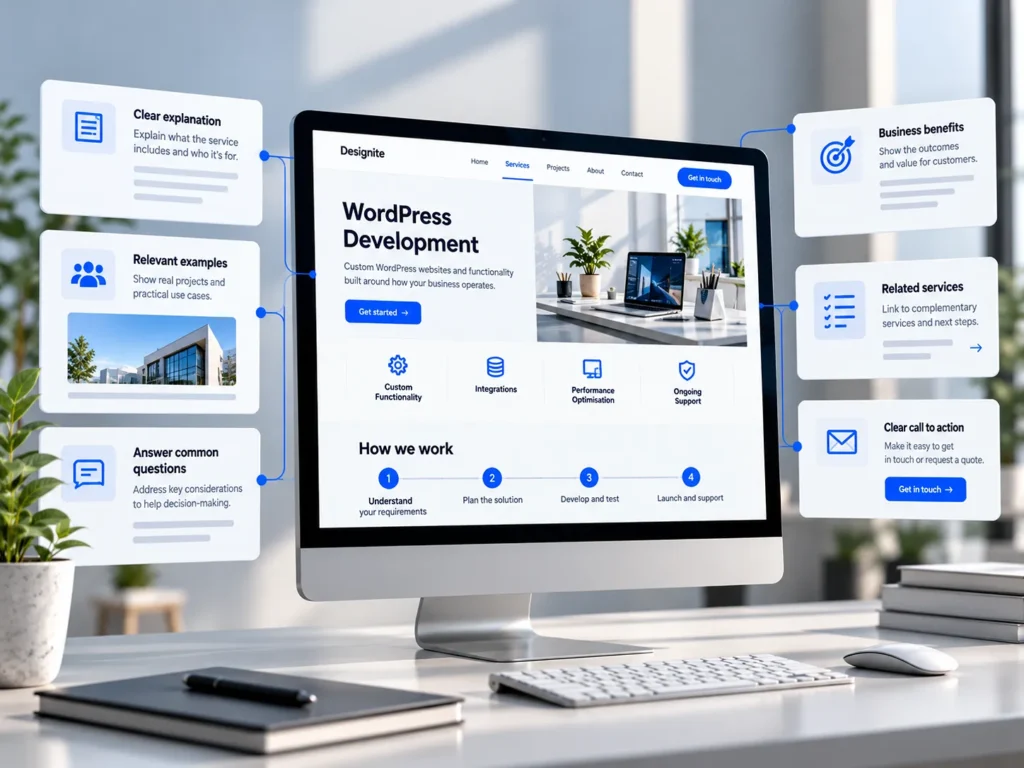
It should help potential customers understand whether the service addresses their requirements, what the work involves, and why the business is a suitable provider.
This requires clear messaging, purposeful content structure, relevant evidence, accessible design, and a contact process aligned with the service.
The result does not need to be an excessively long or complicated page.
Some services require detailed technical explanations, while others benefit from a more concise presentation. What matters is that the information supports the decisions visitors need to make.
At Designite, we approach website design and WordPress development by considering how individual pages contribute to the wider customer journey.
Our goal is to build websites that communicate services clearly, demonstrate practical capabilities, and connect potential customers with the information they need.
If your website describes your services but struggles to generate relevant enquiries, contact Designite to discuss how its content, structure, and functionality could be improved.
A good service page tells visitors what you offer. An effective one helps them understand why it matters to their business.